
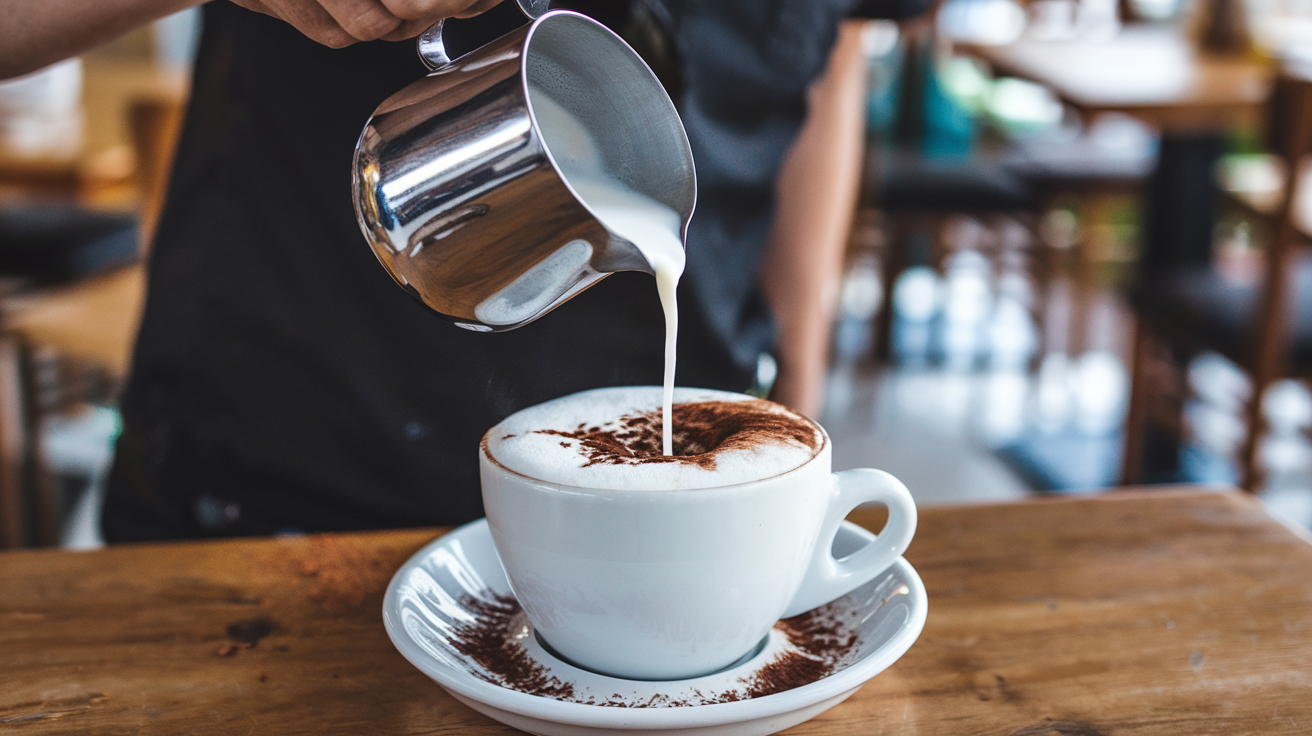
The sound of the steam activating, the dancing milk foam, the delicate cloud of cocoa settling… Just thinking about it, you’re already there. A cappuccino is much more than a drink: it’s a ritual, a moment of comfort, a symbol of the Italian art of living that has conquered the world. But behind this apparent simplicity lies true expertise.
By the way, what exactly is a real cappuccino?
Before diving into the more indulgent variations, let’s go back to basics. What makes a cappuccino a REAL cappuccino? Forget the idea of a simple latte. The real magic lies in a perfect, almost mathematical balance: the golden rule of thirds.
A cappuccino worthy of the name is the perfect harmony between:
- 1/3 strong espresso: This is the heart and soul of your drink. Without a high-quality espresso, rich in aromas, the result will be disappointing.
- 1/3 hot and creamy milk. It softens the strength of the espresso and brings that roundness in the mouth that we love so much.
- 1/3 airy milk foam: That’s the signature! A dense, velvety foam, without large bubbles, which forms a generous dome.
This three-layered structure offers a unique experience. The spoon plunges through the silky foam to reach the smooth blend of milk and coffee. It’s this precise balance that makes all the difference between a good cappuccino and a masterpiece.
Where does this melodious name come from?
Its history is as delightful as the drink itself. Legend has it that its name comes from the Capuchin monks ( cappuccini in Italian). Why? Because the color of the drink, once the coffee was mixed with milk, resembled the color of their hair. While the first versions, called “Kapuziner,” originated in Vienna in the 18th century with a touch of cream, it was in Italy that the magic truly happened.
The invention of the espresso machine at the beginning of the 20th century changed everything. Thanks to its powerful steam, Italian baristas were able to create the smooth milk foam that became the hallmark of the cappuccino. Since then, it has been a cornerstone of our culture, traditionally enjoyed at breakfast to start the day off right.
The ingredients-simplicity in the service of taste
A great cappuccino requires great ingredients. It’s as simple as that. Three elements are essential.
- Coffee, of course: It all starts here. Choose a balanced blend, with a roast that develops chocolate or nutty notes.
- Milk for dreamy foam, whole milk is your best friend. Richer in fat and protein, it guarantees a stable and glossy microfoam. The secret? It must be ice-cold before coming into contact with the heat of the steam wand.
- The finishing touch (or not), A pinch of unsweetened cocoa powder or cinnamon is traditional. This little extra tantalizes the palate and completes the experience.
The preparation ritual
Making a cappuccino is an art. Here are the key steps. First, prepare an espresso (about 30 ml) and pour it into a large, preheated cup. Next comes the crucial step: froth your very cold milk in a stainless steel pitcher. Position the steam wand just below the surface to allow air to enter, then immerse it to heat the milk and create a swirl. The perfect texture? Smooth and glossy like fresh paint. Finally, pour the hot milk over the espresso, holding back the foam, then gently place it on top to form that famous dome.
Cappuccino, Latte, Flat White-we’ll help you understand!
In the world of coffee, it’s easy to feel lost. They all look so similar, and yet… Each one has its own unique character. We’ll explain once and for all how to never confuse them again.
Cappuccino vs. Latte-The Battle of Proportions
This is the most common misconception. The difference lies in one word: ratio. As we’ve seen, a cappuccino is a three-part balance: 1/3 espresso, 1/3 milk, 1/3 foam. Its layer of foam is generous, at least 1 cm thick.
The Caffè Latte, on the other hand, is much milder. It has the same amount of espresso, but is drowned in a larger quantity of hot milk. The foam? Just a thin layer for appearance (about 0.5 cm). In short, the cappuccino is about the love of foam; the latte is about the passion for milk.
Cappuccino vs. Flat White-a question of texture
The Flat White comes straight from Oceania. It falls somewhere between the two, but with an obsession for texture. It’s often prepared with a double espresso, which makes it more full-bodied.
But its true signature is its “micro-foam.” The milk is heated to achieve an incredibly velvety and fine texture, without any visible bubbles. This milk cream is then blended with the espresso for a smooth and silky drink, with just a thin, glossy film on the surface. Goodbye dome of foam, hello caress on the palate.
And the others? Macchiato & Co.
To be thorough, a word about two other cousins. The Macchiato (which means “stained” in Italian) is an espresso simply “marked” with a small dollop of foam. Conversely, the Latte Macchiato is a tall glass of frothed milk into which espresso is delicately poured to create a beautiful layered effect.
How about some fun? The most popular variations
Once you’ve mastered the classic, a world of possibilities opens up. Ready to try your hand at being a barista? Discover the variations that will spice up your coffee break.
Hazelnut cappuccino-the comforting one
A classic for those with a sweet tooth. The roasted flavor of hazelnut is the perfect complement to the bitterness of coffee. Simply add a little hazelnut syrup to the cup before brewing the espresso. For a touch of crunch, sprinkle with a few toasted hazelnut pieces.
The vanilla cappuccino elegant
For a delicate and fragrant touch, vanilla is perfect. Its aroma softens coffee without ever overpowering it. A little vanilla syrup, or for purists, a vanilla bean infused in hot milk, and you’re all set.
Caramel cappuccino-the ultimate gourmand
Warning: a sweet indulgence is on the horizon! The caramel cappuccino is a true dessert in a drink. The rich caramel transforms your coffee into an irresistible confection. Add syrup to your espresso or, for a show-stopping touch, generously drizzle the foam with a smooth caramel sauce.
The Viennese cappuccino-the decadent
Don’t confuse it with its origins! Today’s “Viennese” dessert is pure indulgence. Here, the milk foam is replaced by a mountain of whipped cream (Chantilly), sprinkled with chocolate shavings. An opulent and nostalgic pleasure.
The iced cappuccinois refreshing
Who says cappuccino is just for winter? The iced version is perfect for summer. In a blender, combine a chilled espresso, cold milk, a handful of ice cubes, and a pinch of sugar. Blend until frothy and serve immediately. Pure Italian refreshment!
The best barista, could it be you? Our insider tips
Want to recreate your favorite café’s cappuccino at home? It’s entirely possible. With the right coffee and a few tips, you’ll impress your friends (and yourself).
The choice of grain, the basis of everything
For an espresso with character that doesn’t get overpowered by the milk, opt for an “Italian style” roast, medium or dark.
The art of foam: don’t panic!
This is the step that’s a little scary, but with a bit of practice, it’s a piece of cake. With a steam wand, the secret is a metal pitcher and iced milk. You start at the surface to draw in air, then you plunge to create the swirl that will smooth the texture.
No machine? No problem! Heat your milk in a saucepan (without boiling it). Pour it into a jar, seal tightly, and shake vigorously for 30 seconds. The foam won’t be as fine, but the enjoyment will be just as good!
Add flavoring, yes, but subtly.
For a perfectly flavored cappuccino, the proportions are key. Always pour a small amount of syrup into the bottom of the cup, add the hot espresso, stir well, and only then pour in the milk. This ensures the flavors are evenly distributed.
One more quick question? We have the answers!
Do you have other questions? Here are the answers to the questions we are most often asked.
What is the difference between a cappuccino and a latte?
It’s all about proportions! A cappuccino is 1/3 espresso, 1/3 milk, and 1/3 thick foam. A latte has much more milk and just a light dusting of foam. Therefore, a cappuccino is more intensely coffee-flavored and has a more pronounced foamy texture.
How do I make a cappuccino without an espresso machine?
Easy! Brew a very strong coffee (an Italian moka pot is ideal). Heat some milk. For the foam, use our shaken jar trick or a small battery-operated milk frother. Pour in the coffee, the hot milk, and top with your homemade foam.
Can I use plant-based milk?
Absolutely! “Barista-specific” plant-based milks (oat, soy, etc.) are perfect for this. Oat milk gives a very creamy and smooth result, while soy milk produces a denser foam. Feel free to experiment to find your favorite.
What are the best flavors for a flavored cappuccino?
The classic flavors are hazelnut, vanilla, and caramel. But let your creativity flow! Spices like cinnamon or cardamom are divine. In winter, a gingerbread syrup works wonders. In summer, why not try a coconut syrup?
So, is the origin of the cappuccino Italy or Austria?
Its ancestor (“Kapuziner”) was born in Vienna, but the cappuccino as we love it today, with its smooth steam-made foam, is 100% Italian! It was the invention of the espresso machine that made it possible to create this iconic drink.